The Working Principle of Industrial Chillers



Source:razorteklaser Time:2026-11-26
An industrial chiller is a cooling device widely used in manufacturing, whose core function is to provide stable low-temperature circulating water for equipment or materials during the production process. Simply put, it transfers heat from water
to the environment through a refrigeration cycle, thus achieving continuous cooling of the target object. This device is not a simple "water-cooled fan", but a complete vapor compression refrigeration system, and its design logic and
performance parameters directly affect production efficiency and product quality.
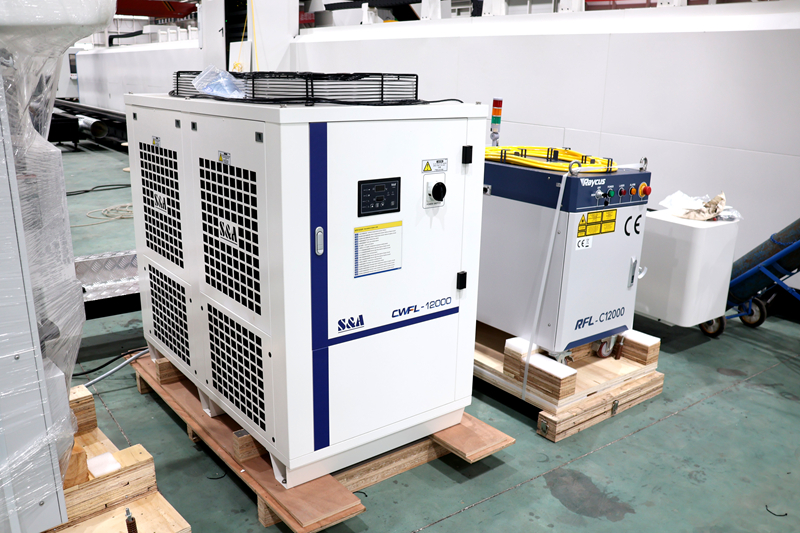
Industrial chillers can be divided into air-cooled chillers and water-cooled chillers. Their working principle is based on the vapor compression refrigeration cycle, and they are mainly composed of four core components: compressor, condenser,
expansion valve, and evaporator. Taking the common air-cooled chiller as an example, its working process is as follows: The compressor compresses low-temperature and low-pressure refrigerant gas into high-temperature and high-pressure
gas, which then enters the condenser. In the air-cooled condenser, the high-temperature refrigerant gas exchanges heat with air through a finned heat exchanger, releases heat, and condenses into high-pressure liquid refrigerant. The liquid
refrigerant is throttled and depressurized by the expansion valve, turning into a low-temperature and low-pressure gas-liquid mixture, which then enters the evaporator. In the evaporator, the refrigerant absorbs the heat from the circulating
water and evaporates, causing the water temperature to decrease. The refrigerant gas is then sucked into the compressor again, completing a cycle. The refrigerant used here, such as Freon, utilizes its characteristic of being able to absorb or
release a large amount of heat during the phase change process to achieve efficient heat transfer.
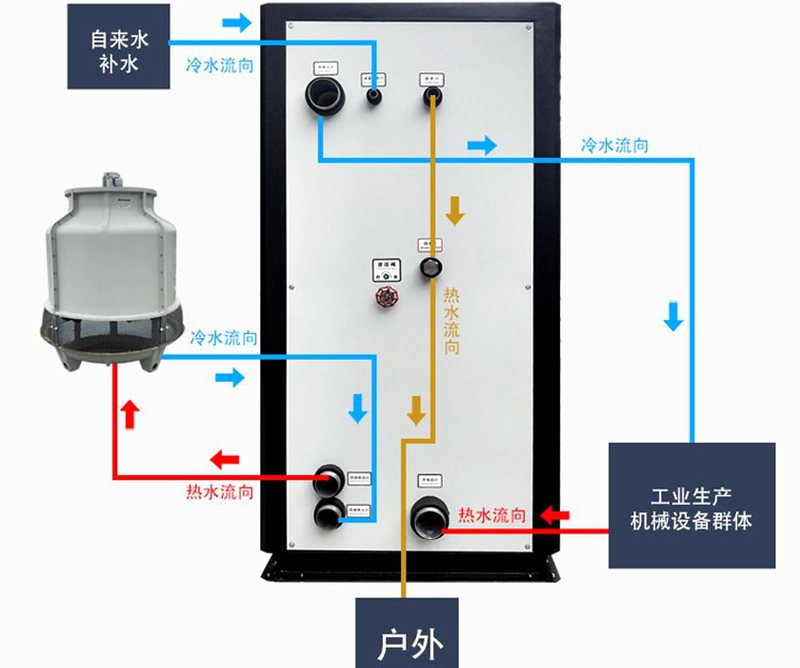
In industry cognition, the performance differences of industrial chillers are primarily reflected in the types of compressors, cooling methods, and control accuracy. Piston compressors are a common choice among traditional models. They
compress refrigerant through the reciprocating motion of pistons within the cylinder, featuring a simple structure and low cost, making them suitable for scenarios with less stringent temperature control requirements. In terms of control
methods, models utilizing PLC (Programmable Logic Controller) can achieve more precise temperature regulation and automated operation, which is particularly important for work processes requiring constant cooling temperature. The
air-cooled cooling method means that the equipment relies on fans to blow air over the condenser for heat dissipation, eliminating the need for additional cooling towers and water systems. This offers flexible installation and is more suitable
for scenarios where water is scarce or space is limited.
In practical applications, the selection of industrial chillers needs to be tailored to specific scenarios. For instance, in the cooling of injection molding machine molds, the role of the chiller is to quickly remove the heat from the mold, shorten
the molding cycle, and prevent product deformation. In this case, there are high requirements for water temperature stability and flow rate. However, in the cooling of laser equipment or medical instruments, more attention is paid to the
temperature control accuracy and reliability of the equipment. Water-cooled chillers have high heat dissipation efficiency and operate more stably, so they are generally more recommended.