CO2 Laser Cutting Machine VS Fiber Laser Cutting Machine



Source:razorteklaser Time:2026-06-03
There are numerous distinguishing factors between CO2 laser cutting machines and fiber laser cutting machines, such as material compatibility, service life, cutting speed, and maintenance costs.
About Fiber Laser Cutting Machines:
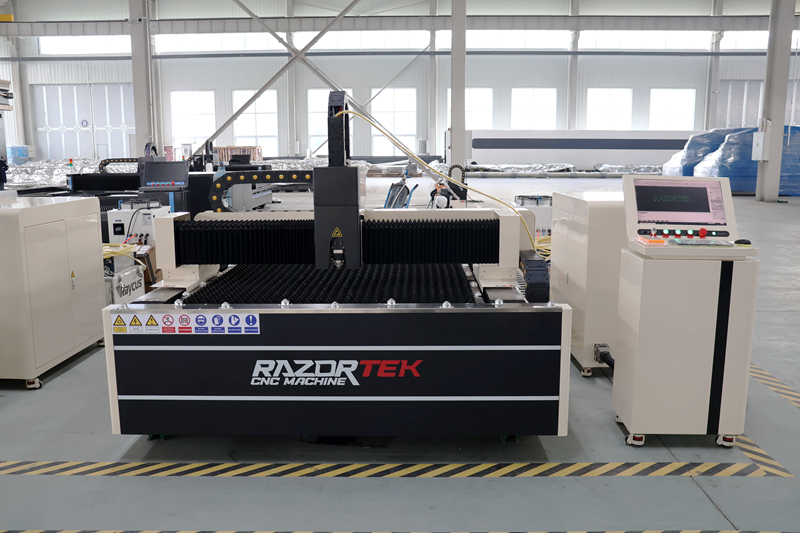
Fiber laser cutting machines utilize a solid-state laser source, typically constructed from fiber optic cables doped with rare earth elements (such as erbium, ytterbium, or neodymium). These lasers generate a high-intensity beam that is guided
through the fiber optic cable and then focused onto the material intended for cutting. Fiber lasers are renowned for their high cutting speeds, precision, and efficiency. They are particularly effective for cutting metals, including stainless steel,
aluminum, brass, and copper. Fiber laser cutting machines are widely employed in industries such as automotive, aerospace, and metal fabrication.
About CO2 Laser Cutting Machines:
A CO2 laser cutting machine is a device commonly used for cutting and engraving various materials. It employs a CO2 laser to generate a high-energy beam, which is then focused onto the material being processed. The intense heat generated
by the laser beam causes the material to vaporize or melt, thereby achieving a precise and clean cut. CO2 laser cutting machines are highly versatile and can be used with a wide range of materials, including wood, acrylic, leather, fabrics, and
more. They are widely utilized across various industries, such as manufacturing, signage, arts and crafts, and rapid prototyping. The high precision, speed, and flexibility of CO2 laser cutting machines make them a popular choice for numerous
applications.
Differences Between Fiber Laser Cutting Machines and CO2 Laser Cutting Machines:
1. Material Compatibility:
Consider the types of materials you intend to process. CO2 lasers are better suited for cutting and engraving non-metallic materials, such as wood, acrylic, and leather. Fiber laser cutting machines, on the other hand, are better suited for metal
cutting and marking applications.
2. Service Life:
CO2 laser cutting machines utilize a gas generator to produce a laser with a wavelength of 10.6 μm, whereas fiber laser cutting machines employ a solid-state laser generator to produce a laser with a wavelength of 1.08 μm. Due to this 1.08
μm wavelength, the laser beam in fiber systems can travel over long distances; consequently, the service life of a fiber laser cutting machine is significantly longer than that of a CO2 laser tube.
3. Losses:
CO2 laser generators rely on mirrors to transmit the laser beam from the oscillator to the processing point. It is necessary to keep these reflectors clean and to regularly replace such consumable parts. Conversely, the optical fiber itself serves
as the active light source in a fiber laser cutting machine; consequently, fiber laser cutting machines experience lower energy losses.
4. Cutting Speed:
The advantage of a shorter wavelength in fiber laser cutting machines allows them to generate a more concentrated beam and a smaller focal spot when cutting stainless steel, carbon steel, brass, copper, and other metal materials. This makes
fiber lasers particularly efficient when cutting medium-thickness materials. When cutting 6mm-thick metal, the cutting speed of a 2kW fiber laser metal cutting machine is comparable to that of a 3kW CO2 laser cutting system.
5. Precision:
CO2 lasers are renowned for their longer wavelength, which enables them to produce finer details and execute intricate designs. However—depending on your specific material requirements—if you intend to process a variety of metals,
utilizing a laser metal cutting machine represents the current industry trend and constitutes your optimal choice. Fiber laser metal cutting machines offer numerous advantages, including high precision, high efficiency, and low operating costs.

6. Cost:
CO2 lasers are generally more affordable, making them a popular choice for small businesses or hobbyists. However, their operating costs—including gas replenishment and maintenance—can be higher. Fiber lasers entail a higher initial
investment cost but offer lower ongoing operating expenses.
7. Photoelectric Conversion Efficiency:
CO2 Lasers vs. Fiber Lasers—Which One Should You Buy? The photoelectric conversion efficiency of a CO2 laser cutting machine is approximately 10% to 15%, whereas that of a fiber laser cutting machine ranges from 35% to 40%. When
cutting the same material, a fiber laser cutting machine operates at a speed that is at least twice that of a CO2 laser cutting machine. This also implies that if one wishes to achieve full penetration of a given material, a CO2 laser will require
significantly more power.
8. Environmental Impact:
CO2 lasers generate a greater amount of heat and necessitate a dedicated cooling system, which consequently increases energy consumption. Fiber lasers are more energy-efficient, generate less heat, and thus have a reduced environmental
impact.
CO2 laser cutting machines are widely utilized in the processing of non-metallic materials, whereas fiber laser cutting machines are predominantly employed within the metalworking industry. Although CO2 laser cutting machines are capable
of cutting metal materials, they have, in recent years, been gradually supplanted by fiber laser cutting machines.